
Eighth Circuit Greenwood Case Dockets
Greenwood County uses South Carolina's term “Circuit Solicitor” for the elected prosecutor. The Eighth Judicial Circuit Solicitor serves Greenwood and Abbeville counties, reviews General Sessions matters, prepares the Greenwood docket, and handles diversion and expungement channels. The Solicitor is not the court-record custodian. Filed Greenwood County case records still come from the Clerk of Court, while defense records remain separate from both offices.
This circuit structure explains why the jail's received charge can change before it reaches a General Sessions docket. Prosecutor review and grand-jury action may alter the counts. Compare the booking event with the filed indictment and the charge-level disposition. When a public docket is unclear, ask the Clerk for the filed paper rather than treating an agency summary as the final court record.
Criminal Court Cases in Greenwood County
Greenwood County criminal court cases do not all begin or end at the same court. The criminal branch of Circuit Court, called the Court of General Sessions in South Carolina, hears felonies and other indictable matters. The Eighth Judicial Circuit Solicitor prepares that docket for Greenwood and Abbeville counties. Greenwood County Magistrate Court handles matters within its summary jurisdiction and performs early criminal functions. Municipal courts hear ordinance and state-law charges within their statutory limits when the conduct arose inside the municipality. Appeals from Magistrate and Municipal Courts can reach Circuit Court.
The Greenwood County Clerk of Court maintains General Sessions warrants, bonds, indictments, filings, fines, and restitution. The clerk, rather than the jail or arresting officer, is the source for the court case file. The Circuit Court page confirms that General Sessions is the criminal side of the court. A case number and the precise court level will make a request much easier.
The official Circuit Court source also shows the Greenwood courthouse and its role in the county case system.
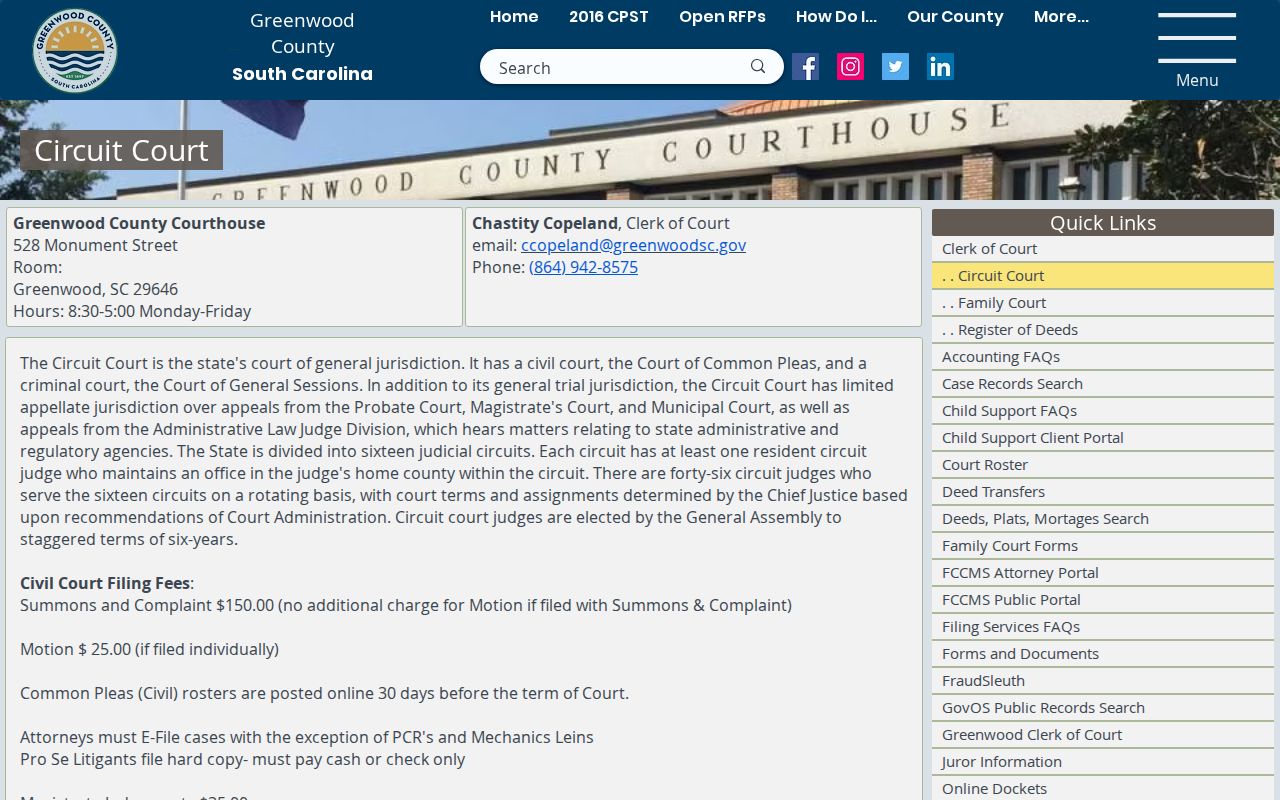
That courthouse source helps distinguish the General Sessions file from a police report or detention record kept at another office.
Greenwood County Court Levels Compared
The charge and where it arose determine which Greenwood County court record to search. South Carolina often places the punishment in the offense statute. Its Class A through F felony schedule does not mean every misdemeanor stays in a lower court. General Sessions handles felony and higher matters. A Magistrate or Municipal Court may retain a summary offense only when the law gives it authority. A municipal conviction may also produce an appeal record at Circuit Court.
| Court | Greenwood role | Best record request |
|---|---|---|
| General Sessions | Felony and indictable criminal cases | Full docket, indictment, plea, disposition, sentence |
| Magistrate Court | Summary cases and preliminary functions | Lower-court docket and final disposition |
| Municipal Court | Authorized city or town offenses | Municipal case record and payment status |
| Circuit Court appeal | Review of lower-court cases | Appeal docket plus the originating court file |
Do not use the Greenwood Clerk's separate official-record search as a replacement for criminal Public Index. That search mainly covers land and recording material. Start with the criminal court level, then match the number and charge.
Greenwood County Case Record Searches
The South Carolina Judicial Branch Case Records Search is the statewide entry point. Choose Greenwood County and the proper court before entering a case number or party name. A broad surname search can help when spelling is uncertain, but a case number is the best exact key. Read each count on its own because one case may contain pending, dismissed, and disposed charges at the same time.
- Open the Judicial Branch gateway, choose Greenwood County, and select General Sessions, Magistrate, or a participating Municipal Court.
- Enter the case number when known. Otherwise, search by last and first name and begin with broad spelling.
- Compare the case caption, charge, filing date, and other visible facts before deciding that a result is the right record.
- Open the details and read charge-level dispositions, bonds, scheduled actions, docket events, and sentence fields separately.
- Give the Greenwood Clerk the case number and exact document title when an image, certified copy, or older event is missing.
| Field label | Type | Required | Notes |
|---|---|---|---|
| County | Selector | Yes | Choose Greenwood at the state gateway. |
| Court | Selector or tab | Yes | General Sessions, Magistrate, or participating Municipal. |
| Case Number | Text | No | Best exact identifier when available. |
| Party Name | Text | No | Use last and first name; search broadly before narrowing. |
| Date range | Dates | No | Filing or event range where the selected court exposes it. |
| Case or Action Type | Dropdown | No | Options change with the court level. |
The official Greenwood Public Index shows how those local case fields appear after a search.
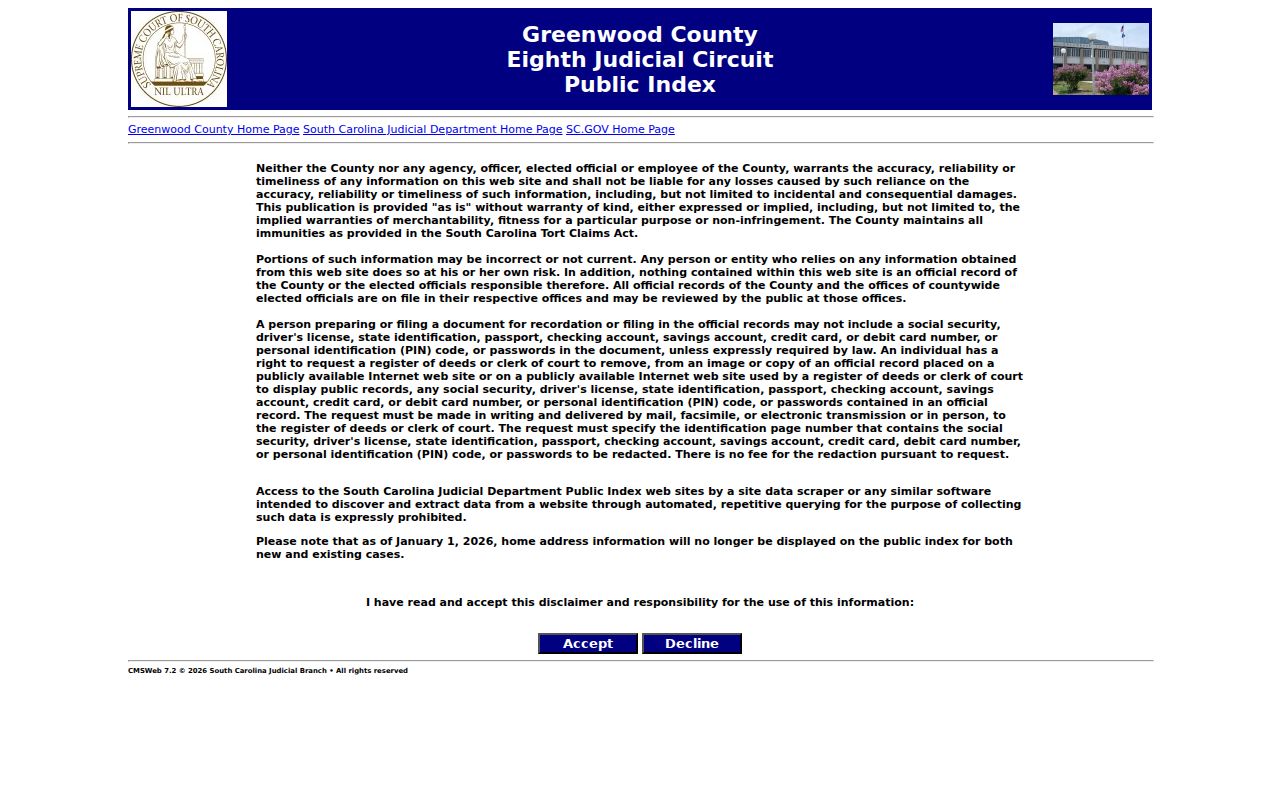
Use the result as a docket map, then request any absent pleading or certified judgment from its custodian.
Missing Greenwood Court Case Documents
A docket row may exist even when its document image does not. The free Greenwood County court case view is not a promise that every warrant, indictment, motion, order, or sentencing sheet can be opened online. Older entries may also have sparse labels. Note the case number, event date, and document description exactly as displayed. Then contact the General Sessions desk for the paper or electronic copy.
The Clerk of Court is at 528 Monument Street, Greenwood, SC 29646. The public counter is listed as open from 8:30 a.m. to 5:00 p.m. on weekdays, excluding major holidays, and the telephone is 864-942-8575. Ask whether the item can be inspected, copied, or certified. The official Greenwood pages do not publish a plain-copy or certified-copy fee, so confirm the charge before ordering. If the case began in Municipal or Magistrate Court, ask that court for its original record as well.
The Greenwood Clerk page identifies the documents held at the General Sessions counter.
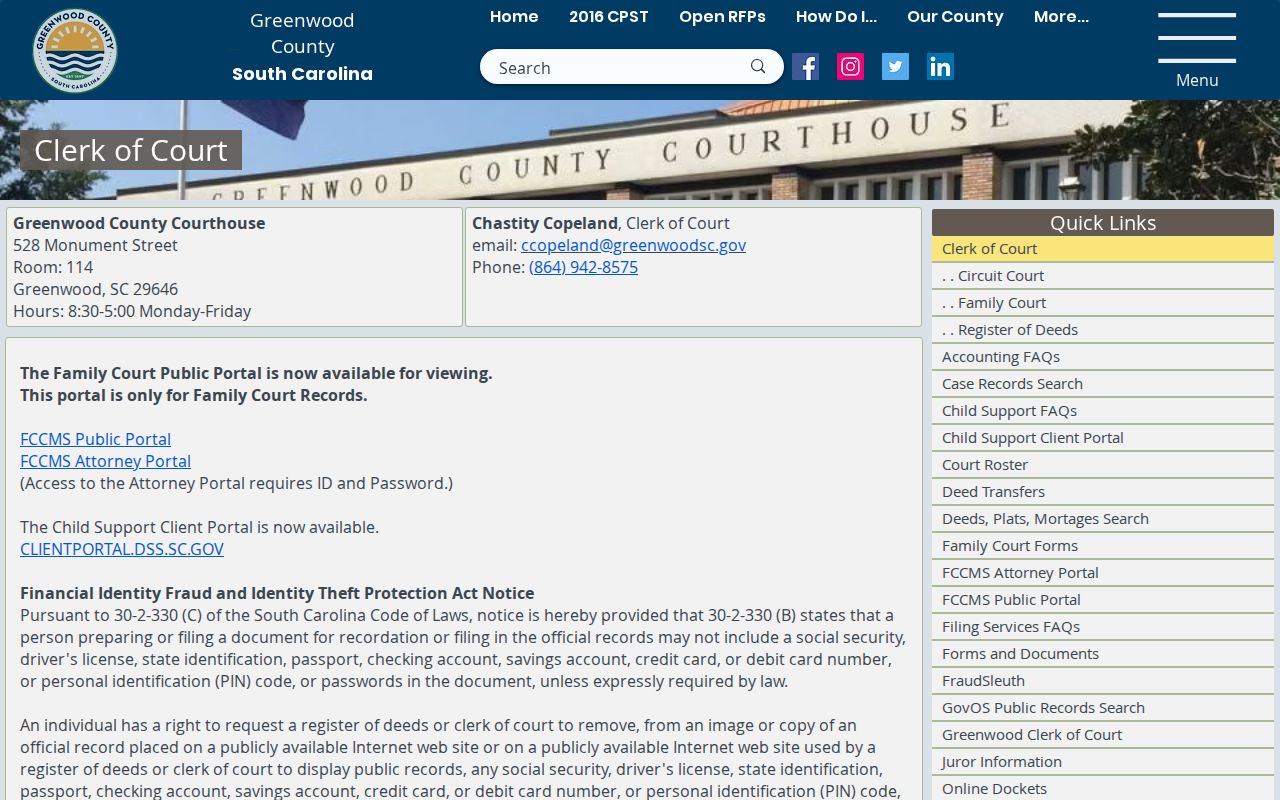
Its listed custody of warrants, bonds, indictments, fines, and restitution explains why an online payment screen alone cannot supply the full case file.
What a Criminal Case File Contains
A Greenwood County court file centers on the filed case, not the intake charge. It can show when the prosecutor changed a count, when counsel appeared, how bond was addressed, and what happened to each accusation. Public images vary. Protected identifiers, victim or minor data, sealed material, and confidential juvenile information should not appear in the open view.
| Case Number and Court | The exact identifier, filing court, case type, filing date, and current status. |
|---|---|
| Charges | Description, count, code or statute when supplied, plus offense and arrest dates where entered. |
| Process and Bond | Warrant, indictment, bond, and related process references when docketed. |
| Docket Entries | Filings, roster events, hearings, pleas, trial activity, and sentencing actions. |
| Disposition | The result for each count, such as guilty, dismissed, nol pros, acquitted, or transferred. |
| Sentence and Money | Sentence terms, fines, assessments, restitution, and balances where the system enables them. |
Compare the filing date with the arrest date. They mark different events. A current booking may appear before the court file is complete, while the final disposition can arrive much later.
Greenwood County Case Disposition Terms
Disposition means the recorded outcome of a charge. It must be read count by count. “Nolle prosequi,” often shortened to nol pros, means the prosecutor ended the charge without a trial finding of guilt. A dismissal also ends a charge, though the reason and eligibility for expungement depend on the record. An acquittal is a not-guilty result after adjudication. A conviction is a judgment of guilt after a plea or verdict.
- True bill
- The grand jury returned an indictment for prosecution.
- No bill
- The grand jury declined the indictment presented.
- Arraignment
- The charge is stated and the defendant enters a plea.
- Restitution
- Money ordered to compensate a victim's proven loss.
- Concurrent sentence
- Two or more terms run at the same time.
These labels describe process or outcome. They do not erase the need to read the linked date, count, and final judgment.
Note: A booking charge can differ from the count the Eighth Circuit Solicitor later files in Greenwood County court.
Criminal Case Stages in Greenwood County
General Sessions cases can pass through investigation, an arrest or warrant, booking, bond and an initial appearance before prosecutor screening and grand-jury action. The indictment is the formal accusation returned by a grand jury. Arraignment follows as the point when the charge is stated and a plea is entered. Discovery, motions, negotiation, trial, sentencing, and appeal may add more docket entries. Lower-level Greenwood County cases can remain in Magistrate or Municipal Court unless appealed or otherwise transferred.
Case flow: Charges Filed › Arraignment › Pretrial › Plea or Trial › Disposition › Sentencing
The flow is a reading aid, not a deadline chart. The research does not provide a reliable Greenwood County timetable for each stage. Use the scheduled-action and docket dates in the individual file.
Certified Greenwood Court Case Dispositions
A screen view may answer a basic status question, but it is not always the record a person needs to correct their own history or prove a final result. Ask the clerk for a certified disposition when official proof of the court outcome is required. Supply the case number, defendant name, court level, and specific count if the case has several charges. Confirm the fee and delivery method because the county court pages reviewed do not publish those copy costs.
The Greenwood court payment interface serves a narrower task. It may show payment-related fields, but it is not a complete court case search or a substitute for the signed judgment. The official view makes that distinction clear.
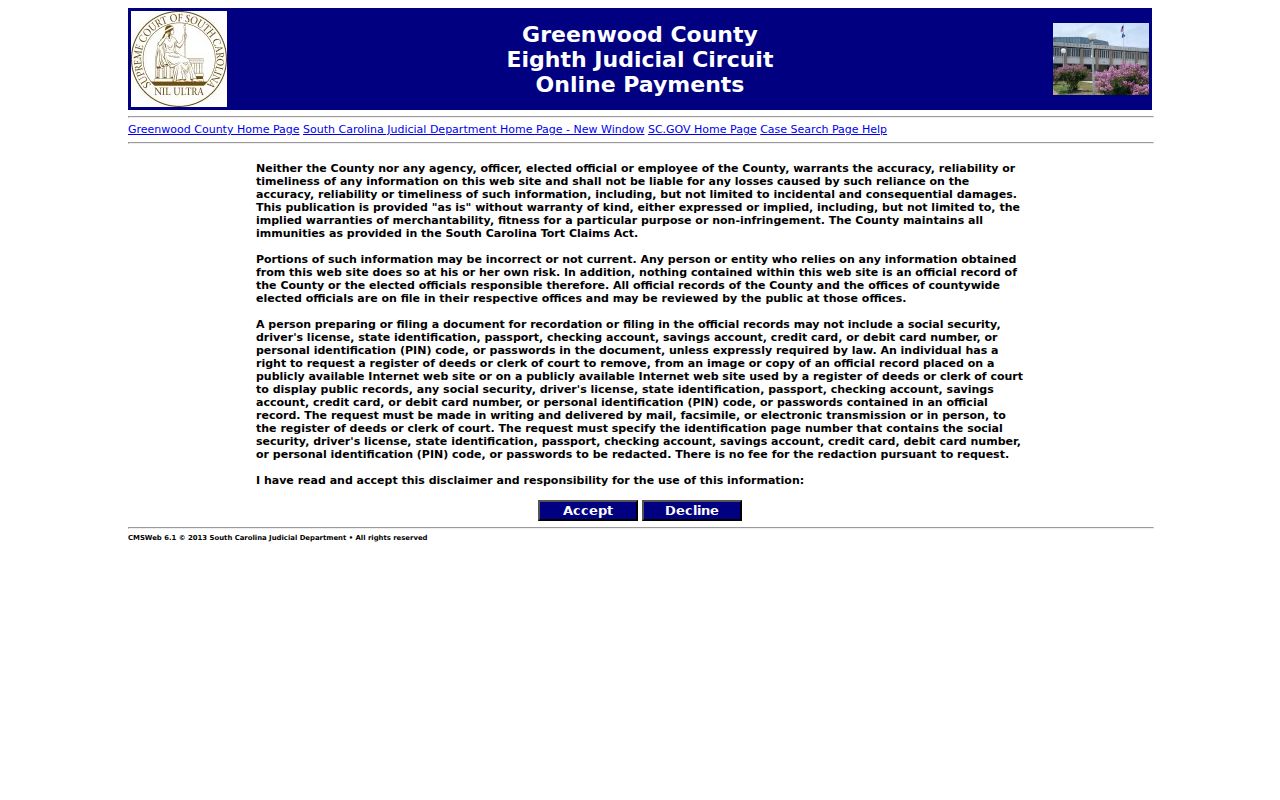
Return to Public Index or the clerk when the question concerns the charge, plea, disposition, sentence, or certification rather than a balance.
Access Rules for Case Records
South Carolina's Freedom of Information Act supports inspection and copying of public records, but court and agency access remains holder-specific. A public body need not create a new report. Exemptions may protect active investigative material, personal identifiers, confidential sources or methods, and other information shielded by law. Juvenile court and Department of Juvenile Justice material is generally confidential.
S.C. Code Section 17-1-40 governs qualifying dismissed, discharged, or acquitted matters and the removal or destruction of certain arrest and booking records. An expunged Greenwood County case should leave ordinary public access, though limited sealed retention may remain for statutory purposes. If a case expected to be removed still appears, contact the issuing court and the Eighth Circuit Solicitor's expungement unit with the exact case information.
For a public record that remains available but is not online, give the custodian a narrow description and ask for inspection or copies. The broader Greenwood County criminal history overview explains why a court docket, jail entry, and SLED repository report can show different parts of the same event.